pIqaD, And How to Read It
Contents
Preface
Throughout this document a text on a green background is used to mark a quote from Okrandian Canon…
…while a red background is used to indicate that the text is a quote from some other material.
This is the beginning of an investigation into the Klingon alphabet and its typographical and phonological nuances. Since there does not really exist any canon Klingon alphabet (Okrand speaks about pIqaD but he never makes use of it.) I have adopted the KLI approved alphabet, used by most klingonists. Paramount themselves use a typeface constructed by the Astra Image Corporation which contains only ten glyphs, but since this is the Klingon alphabet we see in the movies and in Star Trek: The Next Generation, I intend to do a comparison between the two, and hopefully be able to create a typeface which looks more like the pIqaD we see on the silver screen.
I also intend to do a survey of the different styles of usage of pIqaD among klingonists (mainly on the Internet, but other contributions are also welcome if you have any) to see how much one can actually play around with the glyphs and still be able read them.
There are also some images created by Nick Nicholas (one of the people behind the restored version of the Klingon Hamlet) that are quite interesting, as they show what seem to be pIqaD written with a ballpoint pen, a calligraphy pen (in a Fraktur hand – perhaps used in the first printed books on Kronos?), and with a brush. (These images were originally found on KLI’s FTP area in February 2000, but that FTP seems to have gone defunct in intervening years.)
Worth mentioning is also the article “Writing Klingon: The Easy Way” by Theron P. Elliot, (published in HolQeD 2:2 pp.10–11) in which he uses a triangular grid as a basis for writing pIqaD. It is interesting mostly because is also shows the direction of the pen while writing, but otherwise I do not think that the grid makes the Klingon glyphs justice.
Interstellar Language School (lead by Glen F. Proechel) has published “An Alien Writing System Primer” explaining how to write pIqaD in longhand. (It is non-canon, of course – and to my knowledge not endorsed by the KLI.)
Many thanks to Nick Nicholas for his constructive criticism and helpful suggestions.
The Klingon Alphabet (pIqaD)
More recently we’ve been treated to a different alphabet, (often incorrectly attributed to Michael Okuda, scenic designer for TNG), one which corresponds to the phonemes of Klingon as described by Okrand in TKD. While the characters themselves are easily identifiable from background displays on TNG (assuming one has access to video equipment and a reasonably large television screen), there has never been an “official” release describing the particular relationship between individual glyphs and specific sounds. As Okuda has indicated […] all Klingon background displays are composed for appearance, not communication. And yet, an unofficial letter to a Klingon fan group from an unnamed source at Paramount resulted in the following alphabet:
 a |  b |  ch |  D |  e |  gh |  H |  I |  j |
 l |  m |  n |  ng |  o |  p |  q |  Q |  r |
 S |  t |  tlh |  u |  v |  w |  y |  ’ |
Unlike its predecessor, these glyphs provide an excellent fit to the phonology of Klingon, or more specifically that of tlhIngan Hol. However, other questions still remain.
The keen observer of ST6 will note several Klingon glyphs which are not included in the alphabet above. While some appear to be simple rotations of characters (and one is reminded of Sequoyah’s creation of the Cherokee syllabary), other appear to be completely novel. That they are not included in the alphabet need not necessarily be cause for distress, nor tempt us to suspect the assignment of sound to sign. Our own writing system is replete with logographs, single characters representing whole ideas or words (e.g., !, @, #, $, %), clearly a part of the system but not a part of the alphabet.
Then too, it may be helpful to keep in mind Allan Wechsler’s remarks […] on the sparse distribution of consonants in tlhIngan Hol. While perhaps a bit far fetched, the unexplained characters might be instances of alphabetic characters from an earlier, and phonemically larger, form of the language, maintained either for historical purposes in affairs of state (I refer here to the trial scene in ST6), or more simply as decoration.
In any case, there is clearly much much more to be learned about Klingon orthography, more tantalizing promises and secrets to be discovered. Of course it’s unknown whether any further explanations are apt to be forthcoming, but at least the exotica is there. Or, to make the case more clear by example, what precisely is “the Klingon mummification glyph,” and what is its role in a larger writing system? [HolQeD 1:1 pp. 19–20, Lawrence M. Schoen]
And from the syllabary created by Astra Image Corporation (though usually attributed to ST:TNG Scenic Designer Michael Okuda): [HolQeD 1:4 p. 17, Lawrence M. Schoen]
 0 |  1 |  2 |  3 |  4 |  5 |  6 |  7 |  8 |  9 |
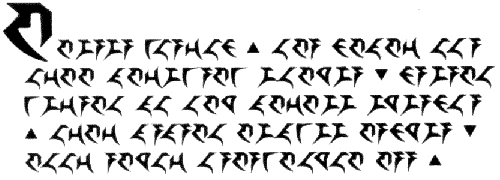
There also exist a “canon” set of Klingon punctuation marks, used on the SkyBox trading cards in their “pIqaD” text. Though the use is somewhat inconsistent on these cards I would like to concur with Nick Nicholas interpretation that the upturned triangle function as a full stop (period) and the downturned triangle as a comma / semicolon. These are also the only punctuation marks that the Klingon language really requires, since both questions and imperatives are clearly marked grammatically.
Pronunciation
The following tables are an overview of the sounds of Klingon, written in IPA. A more complete description of each of the sounds is given in the text below.
| Bilabial | Labiodental | Alveolar | Postalveolar | Retroflex | Palatal | Velar | Uvular | Glottal | ||||||||||
|---|---|---|---|---|---|---|---|---|---|---|---|---|---|---|---|---|---|---|
| Plosive | pʰ | b | tʰ | ɖ | qʰ | ʔ | ||||||||||||
| Nasal | m | n | ŋ | |||||||||||||||
| Trill | r | |||||||||||||||||
| Fricative | v | ʂ | x | ɣ | ||||||||||||||
| Affricate | t͡ɬ | t͡ʃ | d͡ʒ | q͡χ | ||||||||||||||
| Approximant | j | |||||||||||||||||
| Lateral Approximant | l | |||||||||||||||||
| Front | Near-front | Central | Near-back | Back | |
|---|---|---|---|---|---|
| Close | |||||
| Near-close | |||||
| Close-mid | |||||
| Mid | |||||
| Open-mid | |||||
| Near-open | |||||
| Open
| |||||

| Vowel inventory of Klingon | |||
|---|---|---|---|
| [-cons] | [+front] [-back] | [-front] [-back] | [-front] [+back] |
| [+high] [-low] | I | u | |
| [-high] [-low] | e | o | |
| [-high] [+low] | a | ||
There are two noticeable secondary features, [round] and [tense], which are both linked to [back]. The result is that the front vowels are lax. In IPA they would be notated with iota or small capital I, and epsilon rather than with <I> and <e> respectively; presumably the use of <I> is a nod to IPA’s small capital I.
| Consonant inventory of Klingon | ||||||||||||||||
|---|---|---|---|---|---|---|---|---|---|---|---|---|---|---|---|---|
| Bilabial | Labio- dental | Apico- alveolar | Apico- palato- alveolar (possibly) | Apico- domal (retroflex) | Dorso- velar | Dorso- uvular | Glottal | |||||||||
| Stop | p | b | t | D | q | ’ | ||||||||||
| Fricative | v | S | H | gh | ||||||||||||
| Affricate | ch | j | Q | |||||||||||||
| Nasal Stop | m | n | (N) | ng | ||||||||||||
| Glides | w | y | ||||||||||||||
| Trill | r | |||||||||||||||
| Lateral | l | |||||||||||||||
| Lateral Affricate | tlh |
| ||||||||||||||
[HolQeD 1:1, p.3–4]
Doubled Consonants
Though frowned upon by older Klingons it is not all that uncommon that doubled consonants are pronounced as only one letter by younger Klingons. The word qettaH He/she keeps on running, can be pronounced, either (1) with two separately articulated ts in the middle, or (2) with one t held for an extra moment to indicate the doubling, or finally (3) as if it was written with just a single t. [Display Sources]
Alphabet


a [ɑ] Open back unrounded vowel (called ’at when spelling) – As in General American or BBC English spa [spɑː], as in some dialects of German Tag [tʰɑːk] (meaning day), or as in Swedish jаg [jɑːɡ] (meaning I). [Display Sources]
a As in English psalm; never as in American English crabapple. [TKD 1.2]
[a] as in pa [TKDa p. 169]
Younger speakers also have a slight tendency to change the pronunciation of the vowel a in nonstressed syllables to something that sounds a bit like the u in Federation Standard but. If this sound is transcribed with the symbol U, a word like qaleghpu’ (“I have seen you”) might sound more like qUleghpu’. This particular phonological inclination seems particularly bothersome to older Klingons and is generally considered an error worthy of correction. Students who speak this way are customarily reprimanded. [KGT p. 139]


b [b] Voiced bilabial stop (called bay when spelling) – This sound is quite common in Terran languages. It is pronounced as in English aback [əˈbæk], as in German Bub [buːp] (meaning boy) or as in Swedish bra [ˈbrɑː] (good). [Display Sources]


ch [t͡ʃ] Voiceless postalveolar affricate (called chay when spelling) – This sound pronounced as in English bleach [bliːt͡ʃ], as in German Tschinelle [t͡ʃiˈnɛlə] (meaning cymbal), or as in Fenno-Swedish tjugo [t͡ʃʉ:gʉ] (twenty). [Display Sources]


D [ɖ] Voiced retroflex stop (called Day when spelling) – In English, this sound only occur in some dialects, such as in Indian English dine [ɖaɪn] (to eat). The sound is similar to d in dream or android, but the tip of the tongue touches the roof of the mouth further back, at the back of the alveolar ridge (this part of the alveolar ridge is covered with small ridges). As far as I know, this sound does not occur in German.
The D sound exist in most Swedish central and northern dialects. This is how the letters rd are pronounced when they occur together, e.g. in the word nord [nuːɖ] (meaning north). What is actually going on here, phonetically, is that the r causes retroflexation of the following consonant when it comes before a dental consonant. [Display Sources]
D This sound is close to English d in dream or android, but it is not quite the same. The English d sound is made by touching the tip of the tongue to that part of the roof of the mouth just behind the upper teeth. Klingon D can best be approximated by English-speakers by touching the tip of the tongue to the roof of the mouth at a point about halfway between the teeth and the velum (or soft palate), that part of the roof of the mouth that is rather gooshy. As with Klingon b, some speakers pronounce D as if it were more like an nd, and a distinct minority as if it were n—but, of course, with the tongue in the same position as for D. [TKD 1.1]
The sound at the end of the first syllable of this word, toD, is D. To make this sound, point the tip of your tongue directly upwards, and touch the hard part of the roof of your mouth, and the do the same thing you would do to make a d sound. [CK]
For instance Dal means It is boring. To get the first sound in that word right make sure your tongue is pointed straight up towards the roof of your mouth. [PK]


e [ɛ] Open-mid front unrounded vowel (called ’et when spelling) – As in General American or BBC English bed [bɛd], as in German Bett [bɛt] (meaning bed), or as in Swedish en [ɛn] (one). [Display Sources]
e As in English sensor. [TKD 1.2]
[e] as in pet [TKDa p. 169]


gh [ɣ] Voiced velar fricative (called ghay when spelling) – This sound is not like anything in English, German or Swedish. It is produced with the tongue in the same position as for g – as in English gaggle [ˈɡæɡɫ̩], German Lüge [ˈlyːɡə] (meaning lie) or Swedish gång [ɡɔŋː] (path) – but relaxing somewhat and humming. It is a voiced version of the Klingon H sound.
The guttural r [ʁ] of French and southern Swedish dialects is pronounced a bit farther back than the Klingon gh, but is otherwise the identical. (Using a this r instead of the proper gh is not likely to cause confusion, but if doing so one should be aware that one will be speaking with a bit of a Terran accent). [Display Sources]
gh This is not like anything in English. It can be produced by putting the tongue in the same position it would be in to say English g as in gobble, but relaxing the tongue somewhat and humming. It is the same as Klingon H (see below), but with the vocal cords vibrating at the same time. [TKD 1.1]
[gh,] a softer kh, with humming (or voicing) at the same time [TKDa p. 169]
The first sound of the word is gh. It’s the same as the last sound of toDSaH, but hum while you say it. [CK]


H [x] Voiceless velar fricative (called Hay when spelling) – This sound is not common in English but can be heard in some pronunciations of the American exclamation of disgust yech [jɛx]. It also occur in Scottish loch [lɔx], and in German Kuchen [kuːxən] (meaning cake). It is a voiceless version of the Klingon gh. [Display Sources]
H This is also not like anything in English, but it is just like ch in the name of the German composer Bach or in the Yiddish toast l’chaim, or the j in the Mexican city of Tijuana in Baja California. It is produced in the same way as Klingon gh, but is articulated with a very coarse, strong rasp. Unlike Klingon gh, the vocal cords do not vibrate in saying Klingon H. [TKD 1.1]
[H as in] ch in German Bach or Scottish loch [TKDa p. 169]
The last sound in the word is H, this is the same as the sound at the end of the name of the ancient Terran composer Bach. You’d make it the same way you make a k sound, but force air out of your mouth at the same time. [CK]


I [ɪ] Near-close near-front unrounded vowel (called ’It when spelling) – As in English bit [bɪt], as in German bitte [ˈbɪtə] (meaning please), or as in Swedish sill [sɪl] (herring). [Display Sources]
I As English i in misfit. Once in a while, it is pronounced like i in zucchini, but this is very rare and it is not yet known exactly what circumstances account for it. [TKD 1.2]
[i] as in pit [TKDa p. 169]


j [d͡ʒ] Voiced postalveolar affricate (called jay when spelling) – As in English jump [ˈd͡ʒʌmp] or German Dschungel [d͡ʒʊŋəl] (meaning jungle), and similar to dj in Swedish glädje (meaning joy) or kedja (chain). This sound is always pronounced with a hard initial d, and never softly as in French jour (day) or as Swedish jord (earth). [Display Sources]


l [l] Alveolar lateral approximant (called lay when spelling) – As in English let [lɛt], German Liebe [liːbə] (meaning love) or Swedish lång [lɔŋ] (long). [Display Sources]


m [m] Bilabial nasal (called may when spelling) – As in English him [hɪm], German rühmen [ˈʁyːmən] (meaning to praise) or Swedish mask [mask] (worm). [Display Sources]


n [n] Alveolar nasal (called nay when spelling) – As in English nice [naɪs], German Lanze [ˈlant͡sə] (meaning lance), or Swedish nord [nuːɖ] (north). [Display Sources]


ng [ŋ] Velar nasal (called ngay when spelling) – The letters ng are never pronounced separately, but always as in English sing [sɪŋ], German lang [laŋ] (meaning long), or Swedish ingenting [ɪŋːɛntʰɪŋ] (nothing). In the most Terran languages this sound never come at the beginning of a word, but this happen in a number of Klingon words (e.g. ngan inhabitant). [Display Sources]
ng As in English furlong; never as in English engulf. The g is never pronounced as a separate sound. This sound never occurs at the beginning of an English word, but it does come at the beginning at a number of Klingon words. English-speakers may practice making this sound at the beginning of a word by saying English dang it!, then saying it again without the da. [TKD 1.1]
The sound at the beginning of the second syllable, ngan, is the same as the sound that comes at the end of the word thing or hang. [CK]
That sound in the middle of the last word is the same as the sound in the end of the federation standard thing. Be sure to say ngev, not nev or njev. [PK]


o [o] Close-mid back rounded vowel (called ’ot when spelling) – As English go [goː], in German oder [ˈoːdɐ] (meaning or), or as in Swedish åka [ˈoːka] (travel). Note: There are no words ending in *ow (as that is considered indistinguishable from o). [Display Sources]
o As in English mosaic. [TKD 1.2]
[o] as in go [TKDa p. 169]
No words in Klingon have ow or uw. If they did, they would be indistinguishable from words ending in o and u, respectively. [TKD 1.2]


p [pʰ] Aspirated voiceless bilabial stop (called pay when spelling) – As in English pack [pʰæk], German Pack [pʰak] (meaning pile), or Swedish apa [ˈɑːpʰa] (monkey). In Klingon, this sound is always aspirated, that is, released with a strong burst of air. [Display Sources]


q [qʰ] Aspirated voiceless uvular stop (called qay when spelling) – This sound is similar to the k sound of English, German and Swedish but the tongue reaches further back so that it touches the uvula (the fleshy blob that dangles down from the back of the roof of the mouth). In Klingon, this sound is always aspirated, that is, released with a strong burst of air. Notice that this is never pronounced kw as in English quagmire. [Display Sources]
q Similar to English k in kumquat, but not quite that. The tongue position for English k is like that for Klingon gh and H. Indeed, the tongue reaches for or touches the uvula (the fleshy blob that dangles down from the back of the roof of the mouth), so articulating q approximates the sound of choking. The sound is usually accompanied by a slight puff of air. English speakers are reminded that Klingon q is never pronounced kw as in the beginning of English quagmire. [TKD 1.1]
There’s a new sound at both the beginning and end of the second syllable qeq, be careful, this is not the federation standard k sound. You make it like a k, but as you did for Q, shove the back of your tongue as far back into your mouth as you can. [CK]
-qoq – Be sure you pronounce the sound at the beginning and end of this suffix as far back in your mouth as you can. [PK]


Q [q͡χ] Voiceless uvular affricate (called Qay when spelling) – It is pronounced in the same way as q, except that it is held longer while air is forced out. It is very guttural and raspy, somewhat like a blend of Klingon q and H. This sound is quite uncommon in Terran languages. [Display Sources]
Q This is like nothing particularly noteworthy in English. It is and overdone Klingon q. It is identical to q except that it is very guttural and raspy and strongly articulated, somewhat like a blend of Klingon q and H. [TKD 1.1]
To make this sound, put the back of your tongue as far back into your mouth as you can, then force the air up harshly, as if you’re trying to dislodge a piece of food. [CK]


r [r] Alveolar trill (called ray when spelling) – As in Scottish curd [kʌrd], German (in some dialects) Schmarrn [ʃmaːrn] (meaning nonsense), or Swedish rov [ruːv] (prey). This sounds differs from the r of American English, in that it is slightly trilled or rolled.
Or – r [ɹ] Alveolar approximant – Many Americans (among them Marc Okrand, the inventor of the Klingon language) are unable to roll their tongue to produce the trill of r, and therefore the flat r sound of American English is a often heard instead. It should be noted, however, that this pronunciation is a clear indicator of a Terran accent. [Display Sources]


S [ʂ] Voiceless retroflex sibilant (called Say when spelling) – As in the Swedish word fors [fɔʂ] (meaning rapids). This sound is halfway between English s (as in syringe) and sh (as in shuttlecock). It is pronounced with the tongue in the same position as for Klingon D. [Display Sources]
S This sound is halfway between English s and sh, as in syringe and shuttlecock. It is made with the tip of the tongue reaching toward that part of the roof of the mouth which it touches to produce the Klingon D. [TKD 1.1]
It’s not quite either the s or the sh sound you’re familiar with. For the Klingon S, put your tongue in the same place you did to make the D sound, and say it with me. [CK]


t [tʰ] Aspirated voiceless alveolar stop (called tay when spelling) – As in English tick [tʰɪk], as in German Tochter [ˈtʰɔxtɐ] (meaning daughter), or as in Swedish tok [tʰuːk] (fool). In Klingon, this sound is always aspirated, that is, released with a strong burst of air. [Display Sources]


tlh [t͡ɬ] Voiceless alveolar lateral affricate (called tlhay when spelling) – This sound does not occur in many Terran languages, but is common in Nahuatl (the Aztec language). It even occurs in the name of the language Náhuatl [ˈnaːwat͡ɬ].
One way to get the pronunciation right is to start off by saying l. As you do it, pay attention to two things: (1) Your vocal cords are vibrating (if you put your hand on your throat you can feel the vibrations quite clearly), and (2) the tip of the tongue is firmly fixed to the roof of the mouth, with the air passing by on both sides of the tongue.
Now, say l again, but this time without the humming of the vocal cords (whisper!). You should no longer feel any vibrations in the hand on your throat. (The sound you’re now pronouncing in written [ɬ] in IPA.)
Now, say the sound yet again, but this time, spit it out! Build up a little bit of pressure behind the tongue, then push out the air on both sides of it. As before, there should be no humming from your vocal cords, and the tip of the tongue should never leave the roof of your mouth. This is the Klingon tlh sound.
Alternatively, you can think of it as pronouncing a t in a weird way: Instead of lowering the tip of your tongue to let the air pass, keep the tip of the tongue pressed against the roof of the mouth, and lower the sides of the tongue. [Display Sources]
tlh This sound does not occur in English, but is very much like the final sound in tetl, the Aztec word for egg, if properly pronounced. To produce this sound, the tip of the tongue touches the same part of the roof of the mouth it touches for t, the sides of the tongue are lowered away from the side upper teeth, adn the air is forced through the space on both sides between tongue and teeth. The sound is produced with a great deal of friction, and the warning given in the description of Klingon p might be aptly repeated here. [TKD 1.1]
To make this tlh sound, say a t and at the same time whisper, loudly, but still just whisper, an l. […] Do you feel the sides of the tongue going down as you say the sound? – You should. [CK]


u [u] Close back rounded vowel (called ’ut when spelling) – As in General American or BBC English boot [buːt], or as in German Fuß [fuːs] (meaning foot). Note: There are no words ending in *uw (as that is considered indistinguishable from u). [Display Sources]
u As in English gnu or prune; never as in but or cute. [TKD 1.2]
[u] as in soon [TKDa p. 169]
No words in Klingon have ow or uw. If they did, they would be indistinguishable from words ending in o and u, respectively. [TKD 1.2]


v [v] Voiced labiodental fricative (called vay when spelling) – As in English valve [væɫv], German Wächter [ˈvɛçtɐ] (meaning guard) or Swedish vägg [ˈvɛɡ] (wall). [Display Sources]


w [w] Labio-velar approximant (called way when spelling) – As in English weep [wiːp]. [Display Sources]


y [j] Palatal approximant (called yay when spelling) – As in English you [juː], German Joch [jɔx] (meaning yoke), or Swedish jag [jɑːɡ] (meaning I).
Note: Making a clear distinction between y and j sounds are important, not least because of the yI- (you–him/her/it (imperative)) and jI- (I) prefixes. [Display Sources]


’ [ʔ] Glottal stop (called qaghwI’ or just ’ when spelling) – This sound exist in spoken English but is not written – it is the slight catch in the throat between the two syllables of uh-oh or unh-unh, meaning “no.” In some English dialects the letter t is pronounced this way (e.g. Cockney bottle [ˈbɔʔo]). In BBC English the letter t is pronounced this way before n, e.g. in button [bʌʔn̩] (in speech with careful enunciation, however, a proper t sound is often heard instead).
The Swedish term for this sound is glottal klusil (or laryngal klusil) and the sound is, as in English, commonly used, but not written. It is cessation of sound in the middle of öh-oh [œʔœ͜uː] (meaning oops!), or at end of some pronunciations of the word meh [meʔ] (used to express indifference or boredom).
In German this sound is known as Knacklaut and it precedes any word or syllable that begins with a vowel. It has been suggested to me that the difference in pronunciation between alkoholarmm (meaning low in alcohol content) and alkoholarm (made-up word, meaning warning about the destructive effects of alcohol) would be the addition of a glottal stop in the middle.
In Klingon, when ’ comes at the end of a word, the preceding sound is abruptly cut off, and then repeated (after the glottal stop) in a soft whisper. If you articulate the word paw (arrive) and paw’ (collide) there should be a clear and distinct sense of abrupt discontinuation in the latter. [Display Sources]
’ The apostrophe indicates a sound which is frequently uttered, but not written, in English. It is a glottal stop, the slight catch in the throat between the two syllables of uh-oh or unh-unh, meaning “no.” When Klingon ’ comes at the end of a word, the vowel preceeding the ’ is often repeated in a very soft whisper, as if an echo. Thus, Klingon je’ feed almost sound like je’e, where the articulation of the first e is abruptly cut off by the ’, and the second e is an barely audible whisper. When ’ follows w or y at the end of a word, there is often a whispered, echoed u or I respectively. Occasionally the echo is quite audible, with a guttural sound like gh preceeding the echoed vowel. For example, yIlI’ transmit it! can sound more like yIlI’ghI. This extra-heavy echo is heard most often when the speaker is particulary excited or angry. [TKD 1.1]
Did you hear the sounds cut off abruptly in the middle of the word? The correct pronounciation is Qu’vatlh, not Quvatlh. This abrupt cut-off is a very common feature of Klingon, you’ll hear it a lot. [CK]
-na’ Notice how the sound stops abruptly at the end of this suffix, it’s -na’, not -naaa. [PK]
Many nonnative speakers of Klingon, especially those for whom Federation Standard is a first language, seem to have trouble with ’, the glottal stop, at the end of a word. Articulated correctly, ’ is simply a very abrupt cessation of vocalization. The most common mispronunciation of ’ is as q, though some newer speakers leave ’ off altogether. Errors of this type could lead to confusion or confrontation. [KGT pp. 194–195]
Stress
The instructions for stress given here are equivalent to those given in TKD, (in that stress will wind up in the same places), however, here they have been simplified quite a bit to ease look-up and memorization.
Stress is not normally indicated when writing Klingon, and the only piece of Klingon canon where stress is shown is the pronunciation key of the sentences in the TKD “cheat sheet” [TKD pp. 171–172]. In that pronunciation respelling HIjol (Beam me aboard) is written “khi-JOL”. [Display Sources]
Verbs
Adjectival verbs are stressed as verbs.
- If a speaker emphasizes one or more suffixes, then those suffixes are stressed, and all other syllables are unstressed. (Commonly emphasized suffixes are: -’a’, -be’, -Qo’, -Ha’ and -qu’.)
- Otherwise, the last syllable of the stem is stressed, the first suffix is unstressed, and, after that, all suffixes ending in glottal stop are stressed.
In a verb, the stressed syllable is usually the verb itself, as opposed to any prefix or suffix. If, however, a suffix ending with ’ is separated from the verb by at least one other suffix, both the verb and the suffix ending in ’ are stressed. In addition, if the meaning of any particular suffix is to be emphasized, the stress may shift to that syllable. Suffixes indicating negation or emphasis (section 4.3) are frequently stressed, as is the interrogative suffix (section 4.2.9). [TKD 1.3]
[…] A younger speaker, on the other hand, may pronounce the word [qettaH] as if it were qetaH, though with the stress remaining on the first syllable as it is in qettaH. [KGT p. 138]
Younger speakers also have a slight tendency to change the pronunciation of the vowel a in nonstressed syllables to something that sounds a bit like the u in Federation Standard but. If this sound is transcribed with the symbol U, a word like qaleghpu’ (“I have seen you”) might sound more like qUleghpu’. [KGT p. 139]
Verbs are likewise stressed on the final syllable of the stem: Dál to be boring, ghIpDÍj to court-martial. Unlike nouns, if the first suffix after the verb ends in a glottal stop, the suffix is not stressed. Thus the verb she has been an alien is nóvpu’, while the noun aliens in novpú’. If the suffix ending in a glottal stop is other than the first, then both it and the final syllable of the verb are stressed: mughIpDÍjchoHDÍ’ when she started court-martialling me, HóH’eghrupmó’ because he was ready to suicide.
Semantically important suffixes can end up stressed instead of the verb stem. In practice in Klingon metre (which systematises this tendency) negative and interrogative suffixes are always stressed: jIDalbé’ I am not boring, bImatlhHá’ you are disloyal, luDelQó’ they refuse to describe it, chol’á’ is he coming? Note that adjectival verbs are considered verbs: ’útlh mátlhqu’ a truly loyal officer. There are often cases where monosyllabic verbs and nouns are juxtaposed. In this text, adjectival verbs and subject nouns tend to be stressed more strongly, following an iambic pattern. Thus ’utlh mátlh a loyal officer, matlh ’útlh the officer is loyal. [Hamlet (pocket edition), Appendix II, pp. 215–216]
Nouns
Nominalized verbs (nouns created using suffixes -wI’ and -ghach) are stressed as nouns.
- If there are syllables ending in glottal stop, those are stressed (and stressed equally).
- Otherwise, the last syllable of the stem is stressed (in compound nouns, only the last syllable of the last stem is stressed).
In a noun, the stressed syllable is usually the syllable right before the first noun suffix, or the final syllable if there is no suffix. If, however, a syllable ending in ’ is present, it is usually stressed instead. If there are two syllables in a row ’ both ending in ’, both are equally stressed. [TKD 1.3]
Nouns are stressed on the final syllable of the stem: ghóp hand, puyjáq nova, bortáS revenge. Any suffixes added on to the stem are not stressed: puyjáqvam this nova, bortáSmey revenges.
However, if any syllable in a noun, whether in the stem or in a suffix, ends in a glottal stop, it is stressed instead of the stem’s final syllable. Thus: bó’DIj court, ghopDú’ hands, puyjaqvó’ from the nova. Adjacent syllables ending in glottal stops receive equal stress: chú’wÍ’ trigger, although Klingon verse tends to stress the latter. Note that nouns derived from verbs are considered nouns: vúm to work, vumwÍ’ worker, vumtaHghách working, vumpú’ghach a bout of work. [Hamlet (pocket edition), Appendix II, pp. 215–216]
The Rest
Everything we know about stress in chuvmey comes from the few examples of exclamations that occur in the TKD “cheat sheet”, and all of these have their final syllable stressed.
- Final syllable is stressed.
Numerals
| Value | Pronunciation | pIqaD | Name | |
|---|---|---|---|---|

| 
|
| 
| zero, none |

| 
|
| 
| one |

| 
|
| 
| two |

| 
|
| 
| three |

| 
|
| 
| four |

| 
|
| 
| five |

| 
|
| 
| six |

| 
|
| 
| seven |

| 
|
| 
| eight |

| 
|
| 
| nine |
Klingon originally had a ternary number system; that is, one based on three. Counting proceeded as follows: 1, 2, 3; 3+1, 3+2, 3+3; 2×3+1, 2×3+2, 2×3+3; 3×3+1, 3×3+2, 3×3+3; and the it got complicated. In accordance with the more accepted practice, the Klingon Empire sometime back adopted a decimal number system, one based on ten.
Though no one knows for sure, it is likely that this change was made more out of concern for understanding the scientific data of other civilizations than out of a spirit of cooperation. [TKD pp. 52–53]
Older Klingon music was based on a nonatonic scale—that is, one made up of nine tones. Each tone has a specific name, comparable to the “do, re, mi” system used in describing music on Earth. The nine tone names are (the first and ninth, as with Earth’s “do,” being the same): yu, bIm, ’egh, loS, vagh, jav, Soch, chorgh, yu. While the first three (and ninth) of these words apparently are used only for singing the scale, the remaining five are also numerals: loS, “four”; vagh, “five”; jav, “six”; Soch, “seven”; chorgh, “eight.” It is possible that, at some time in the past, the numerals were “borrowed” into the lexicon of music in order to sing the scale but, for some reason, the first three (presumably wa’, cha’, wej [“one, two, three”]) were either changed or never used. It is far more likely, however, that the borrowing went in the other direction. As is well documented, the Klingon counting system was originally a ternary system (one based on three, with numbers higher than three formed from the words for “one,” “two,” and “three”). Later, owing to outside influences, it changed to a decimal system (based on ten). The independent words for the numbers three through nine were not originally a part of the Klingon counting system, but they had to come from somewhere. The musical scale is the likely source. The word for the fourth musical tone, loS, began to be used for the number four, and so on through the eighth tone, chorgh. (The origins of the words Hut [“nine”] and the suffix -maH, used in the words for “ten,” “twenty,” “thirty,” and so on, are obscure.) [KGT pp. 72–73]
Dialects
We have known that there are more than one Klingon dialect ever since TKD (which hinted at this in the description of the sounds b, n and m in “The Sounds of Klingon”) but most of the information we have today we got with KGT (which described the below listed dialects, as well as some other variations in speech related to the speaker’s age, and social class). [Display Sources]
b As in English bronchitis or gazebo. Some Klingons pronounce this sound as if it were m and b articulated almost simultaneously. Speakers of English can approximate this sound by saying imbalance without the initial i sound. A very small number of Klingons pronounce b as if it were m.
[…]
n As in English nectarine or sunspot. Those Klingons who pronounce D more like n can easily articulate and hear the two sounds differently. Even a D that sounds like n is pronounced with the tongue in the Klingon D position, not in the English d position. Klingon n is produced with the tongue in same position as English d.
m As in English mud or pneumatic. Those few Klingons who pronounce b as m would say Klingon baH fire (a torpedo) and maH we the same way, and have to memorize which word is spelled which way. [TKD 1.1]
The Tak’ev Dialect
Dialect spoken in the Tak’ev (taq’ev) region. It is one of the larger minority dialects and has a much greater number of speakers that the Krotmag dialect. It sounds like blend of Krotmag an Standard Klingon, and is the one dialect (that we know of) which most closely resembles Standard Klingon. It is only briefly described in canon.
- Nasal vowels
- Pronounces b as mb
- Pronounces D as ND
The Krotmag Dialect
Dialect spoken in the Krotmag (Qotmagh) region. This dialect has fewer speakers than the Tak’ev dialect, but is well known and easily recognized by other Klingons. Some of the dialects peculiarities have even influenced Standard Klingon.
- Nasal vowels
- Pronounces b as m (as in English mime)
- Pronounces D as N
- Often uses extra words in noun phrases, originally to differentiate between words with b and m (e.g. ’uS qam leg foot, nach qam head face), but now prevalent even when no disambiguation is needed (e.g. NeS ghop arm hand, nach ghIch head nose, qorNu’ tuq family house and even yan ’etlh or ’etlh yan sword sword)
- Often adds short extra sentences to disambiguate between verbs with b and m (e.g. mImoH. yIjotchoH. You’re impatient. Calm down!, mImoH. ’oy’ mInNu’wIj. You’re ugly. My eyes ache.)
Those in the Krotmag (Qotmagh) region, for example, have characteristic ways of pronouncing the sounds b and D, as well as the vowels. In ta’ Hol, b is pronounced the same as b in Federation Standard bribe. In the Krotmag dialect of Klingon, however, b and m are pronounced identically, both of them sounding like Federation Standard m as in mime. Thus, for example, the members of the following pairs of words sound exactly alike in the Krotmag dialect; however, they sound different in Standard Klingon:
bup (“quit”)/mup (“strike”)
boH (“be impatient”)/moH (“be ugly”)
buS (“concentrate on”)/muS (“hate”)
ghob (“wage war”)/ghom (“meet, encounter”)
qab (“face”)/qam (“foot”)
Qub (“think”)/Qum (“communicate”)
teb (“fill”)/tem (“deny”)
For the most part, this causes no problems for Krotmag dialect speakers. There are more homonyms (words that sound alike) in their dialect than in other dialects, but, as is the case with homonyms in general, context usually serves to clarify which word is meant. Occasionally, however, two identically pronounced words can be used in such similar contexts, raising the possibilities of at least ambiguity if not catastrophic misunderstanding, that some interesting speech patterns have developed. When there are nouns that sound alike, speakers are likely to use compound nouns (that is, use two nouns where otherwise one would do). This is probably most clearly seen with the pair of words meaning “face” and “foot,” both pronounced qam (though “face” is qab in Standard Klingon). Does qamlIj vIghov mean “I recognize your foot” or “I recognize your face”? Unless the course of the discussion clearly dictates which is meant (as it might, for example, in a conversation when buying shoes, though even here the possibility for ambiguity exists), there is no way to tell. In such a situation, “foot” would probably be rendered ’uS qam (literally, “leg foot”); “face” would be nach qam (or, in the standard dialect, nach qab—literally, “head face”). Interestingly, though originally used only to avoid ambiguity with words containing m and b, these speech patterns have become quite common in the Krotmag region and are used even when m and b are not involved in the words at all. Thus, it would not be unusual to hear such utterances as DeS ghop (actually, NeS ghop—the meaning of N is explained below) meaning “arm hand” or nach ghIch (“head nose”), even though the single words ghop (“hand”) and ghIch (“nose”) need no disambiguation. Similarly, a house (lineage) is frequently called qorDu’ tuq (actually, qorNu’ tuq)—literally, “family house”—rather than tuq (“house”) alone, and a sword is often termed yan ’etlh (or even ’etlh yan)—literally, “sword sword.” This manner of speaking is quite characteristic of this region.
For verbs, a somewhat different tactic is employed. In ta’ Hol, there is no problem distinguishing bIboH (“You are impatient”) from bImoH (“You are ugly”). In the Krotmag region, however, both are pronounced mImoH. To make the speaker’s intent clear, it is not uncommon to add a short sentence immediately after the potentially ambiguous one:
mImoH. yIjotchoH.
[Standard: bIboH. yIjotchoH.]
(“You’re impatient. Calm down!”)
mImoH. ’oy’ mInNu’wIj.
[Standard: bImoH. ’oy’ mInDu’wIj.]
(“You’re ugly. My eyes ache.”)
(See below regarding Krotmag N.)
Krotmag dialect speakers have a distinctive pronounciation of D as well: it sounds like n, except the tip of the tongue touches a point in the middle of the roof of the mouth rather than one behind the top teeth as it does for n. (For the sake of clarity in this discussion the way Krotmag dialect speakers pronounce D will be written N, to distingguish if from n.) The D sound in ta’ Hol is also produced with the tongue pointing upward and not near the teeth (just like N), but otherwise the D sound is similar to that of Federation Standard d as in did. For speakers in the Krotmag region, the sounds n and N are distinct; the following pairs of words do not sound the same (the standard form of the second member of each pair follows in brackets):
naH (“fruit, vegetable”)/NaH (“now”) [DaH]
nuj (“mouth”)/Nuj (“vessel”) [Duj]
mIn (“eye”)/mIN (“colony”) [mID]
nulegh (“He/she sees us.”)/Nulegh (“He/she sees you.”) [Dulegh]
Though under most circumstances, speakers of the Krotmag dialect can easily distinguish between the two sounds, it is not unusual to hear a speaker add extra elements, as if to ensure clarity: maH nulegh—literally, “us, he/she sees us”; SoH Nulegh—literally, “you, he/she sees you.” This does not happen anywhere nearly as frequently as it does with words with b or m, however. Speakers of other forms of Klingon, on the other hand, find the Krotmag pronunciations of N and n to be so similar as to be indistinguishable. When trying to speak in the Krotmag manner, they tend to pronounce all words with D as if they used n instead, rather than N, making it possible for a true Krotmag speaker to differentiate a fellow resident from an outsider, but also making communication difficult. Misunderstandings, sometimes with unfortunate consequences, are not all that uncommon.
A third characteristic of the Krotmag accent is the nasal quality of the vowels, caused by the air being expelled through the mouth and nose at the same time while speaking. This in no way impedes communication with speakers of other dialects, but it does give the dialect a distinct tone.
Although the number of speakers of the dialect of the Krotmag region is relatively small, their speech patterns are well known and easily recognized and have actually had an effect on other dialects. It is not uncommon for speakers of one dialect to imitate the speech of another, whether as a way to mock the speakers of a nonstandard dialect or as a way to learn about that dialect to be prepared for a change in leadership. A bit of dialect mixture results, with words or pronunciations of one dialect being added to another. The distinctive pronunciations of the Krotmag dialect are surely responsible for some slang and idiomatic usages in Klingon in general. For example, chab chu’ (literally, “new pie”) is another way to say “new invention” or “latest innovation.” This is no doubt because the Krotmag pronunciation of chab (“pie”) is cham, the same as the word for “technology.” Similarly, a slang word for “sword” is yaD (literally, “toe”), based on the Krotmag pronunciation of yaD as yaN, which to most Klingons will sound like yan (“sword”). [KGT pp. 18–22]
The Morskan Dialect
Dialect spoken on the conquered Klingon world Morska. We’re treated to brief bout of the Morskan dialect of Klingon in ST6 when Enterprise encounters a Klingon listening post. (The Klingon spelling of the word “Morska” is unknown – the only canon occurrence is in spoken form, in the Morskan dialect, by that guard in ST6).
The Morskan dialect is characterized by the following speech patterns.
- Pronounces tlh as ghl at the beginning of syllables, and as ts (as in English cats) at the end
- Pronounces H as h (as in English hat) at beginning of syllables, and not pronounced at all at end
- Pronounces Q as Standard Klingon H
- Usually drops -’e’ from the final noun in “to be” phrases (except when the subject of such phrases are emphasised)
In addition to the regions on Kronos (and there are more than those mentioned above), of course, are the various planets that have become part of the Empire. On some, such as Morska, a dialect of Klingon has all but replaced any languages originally spoken; on others, such as Vaq’aj II, native languages survive alongside ta’ Hol. Interestingly, the dialects of Klingon spoken on conquered planets are not as different from ta’ Hol as are some of the dialects on Kronos itself. That is because the Klingon language came to the conquered planets relatively recently and therefore remains somewhat similar to that spoken by the conquerors, while the dialects on Kronos have been spoken for a much longer period and have had time to develop differently. [KGT p. 18]
The speech of residents of the planet Morska has some identifiable phonological characteristics also. Most striking is the absence of the sound tlh. Syllables ending with tlh in most dialects end with ts (pronounced the same as ts in Federation Standard cats) in the Morskan dialect; at the beginning of syllables, instead of saying tlh, Morskans say something that sounds very much like a combination of standard Klingon gh and l—that is, ghl. Compare, for example (Morskan/ta’ Hol):
ghIts/ghItlh (“write”)
mats/matlh (“be loyal”)
ghlIngan/tlhIngan (“Klingon”)
ghlo’/tlho’ (“thank”)
ghluts/tlhutlh (“drink”)
The Morskan dialect also pronounces H differently from the standard way. At the beginning of syllables, H sounds like Federation Standard h as in hat; at the ends of syllables, H is not pronounced at all:
hIv/HIv (“attack”)
ba/baH (“fire [a torpedo]”)
hu/HuH (“bile”)
Finally, Q at the beginning of syllables is pronounced the same as standard Klingon H:
Hapla’/Qapla’ (“success”)
Hoy/Qoy (“hear”)
Because of this pronunciation difference, sometimes speakers of the Morskan dialect and those of ta’ Hol misunderstand one another. Words such as the following have been responsible for the loss of more than one life:
Hagh: Morskan, “make a mistake”/Standard, “laugh”
Hoj: Morskan, “make war”/Standard, “be cautious”
HoS: Morskan, “be sorry”/Standard, “be strong”
Grammar
Although the basic grammar of all dialects of Klingon is the same, there is some variation. The Morskan dialect, for example, does not put the suffix -’e’ on the subject noun in a sentence translated with “to be” in Federation Standard (though the suffix is not missing in other contexts where it is used to focus attention on one noun rather than another within the sentence). Compare:
Morskan: tera’ngan gha qama’. (“The prisoner is a Terran.”)
Standard: tera’ngan ghaH qama’’e’ (tera’ngan, “Terran”; ghaH, “he, she”; qama’, “prisoner”)
Morskan: bIghha’Daq ghata qama’. (“The prisoner is in the prison.”)
Standard: bIghHa’Daq ghaHtaH qama’’e’. (bIghHa’Daq, “in the prison”; -taH, “continuous”)
Sometimes the -’e’ is heard at the end of the subject noun in Morskan sentences of this type (qama’ [“prisoner”] in the examples above), leading some speakers of ta’ Hol to criticize speakers of the Morskan dialect for sloppiness, claiming that sometimes the -’e’ is heard and other times not, with no apparent pattern. The critics are wrong: -’e’ added to qama’ in the Morskan sentences would have its usual focusing function (the sentences would mean something like “It’s the prisoner who’s a Terran” and “It’s the prisoner who’s in the prison,” respectively), the same as it would have in sentences of other types. This grammatical device is not available to speakers of ta’ Hol who, to speak grammatically, must use -’e’ in sentences of this type whether wishing to call extra attention to the subject noun or not. [KGT pp. 22–24]
References
- Elliot, Theron P. “Writing Klingon: The Easy Way.” In HolQeD, Volume 2, Number 2 (). Lake Forest: Klingon Language Institute.
- Okrand, Marc. . The Klingon Dictionary. New York: Pocket Books, Simon & Schuster Inc.
- Okrand, Marc. . Conversational Klingon. Audio cassette. New York: Simon & Schuster Audioworks.
- Okrand, Marc, and Levine, Barry. . Power Klingon. Audio cassette. New York: Simon & Schuster Audioworks.
- Okrand, Marc. . Klingon for the Galactic Traveler. New York: Pocket Books, Simon & Schuster Inc.
- Pullum, Geoffrey K., and Ladusaw, William A. . Phonetic Symbol Guide. Chicago: The University of Chicago Press.
- Schoen, Lawrence M. “Some Comments on Orthography” In HolQeD, Volume 1, Number 1 (). Lake Forest: Klingon Language Institute.
- Schoen, Lawrence M. “Numerals” In HolQeD, Volume 1, Number 4 (). Lake Forest: Klingon Language Institute.
- Wechsler, Allan C. “First Steps Towards a Phonological Theory of Klingon.” In HolQeD, Volume 1, Number 1 (). Lake Forest: Klingon Language Institute.
- Wells, Teresa Lynn. . A Survey of the Artificial Language tlhIngan Hol: From Creation to Creativity. A Thesis Presented in Partial Fulfillment of the Requirements for the Degree Master of Arts at Arizona State University. Unpublished.